The BMID Action Loop
Use the six steps—Notice, Name, Reframe, Align, Act, Reflect—to respond to a body-story trigger with a small, values-aligned choice, then review what happened.
Resources Books Body Mass Identity
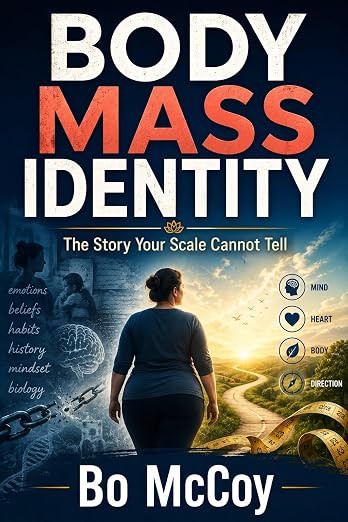
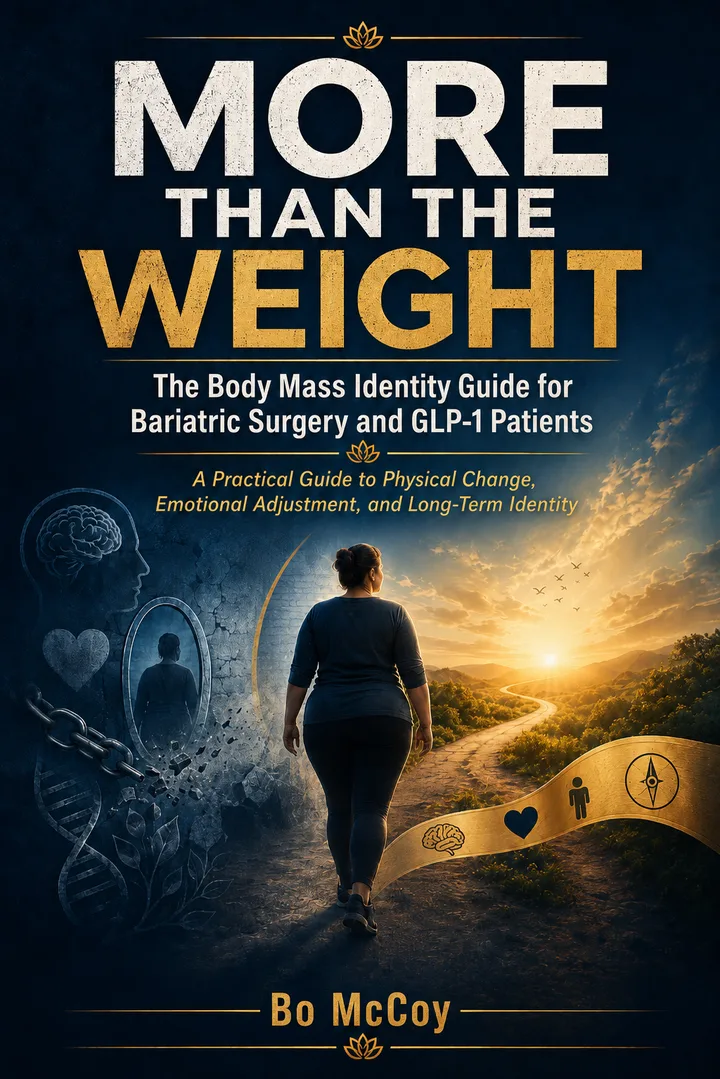
Book · Manifested Identity
An identity-focused look at the story a person carries about their body, beyond a number on the scale. This is not a diet plan or medical treatment guide; it offers reflection, language, and practical tools for a more compassionate relationship with change.
Find your starting point
A closer look inside
Selected chapters and themes show how the book develops its ideas, from understanding the problem to putting the work into practice.
Defines Body Mass Identity as the story one carries about themselves and introduces BMI-Q as a tool for measuring life experience rather than medical status.
Explores seven patterns of body stories, including Hidden, Survival, Shame-Burdened, Failed-Attempt, Divided, Rebuilding, and Aligned identities.
Examines the ten specific domains of the BMI-Q profile, such as Body Story Awareness, Shame Load, and Quality of Life, to detail daily life impacts.
Challenges the assumption that struggles are character flaws by reframing them as burdens and identifying strengths used to carry them.
Introduces the six-step BMID Action Loop—Notice, Name, Reframe, Align, Act, Reflect—for addressing body story triggers in real-time.
Focuses on reclaiming aspects of life previously restricted by body image and uses behavior experiments to test old stories.
Looks forward by helping readers articulate a Future Body Identity Statement and create a flexible Forward Plan for continued support.
From reading to practice
These are named practices and reflection tools included in the book—not additional products or promised outcomes.
Use the six steps—Notice, Name, Reframe, Align, Act, Reflect—to respond to a body-story trigger with a small, values-aligned choice, then review what happened.
A five-part reflection method: name the shame statement, trace the source, notice the effect, write a dignity-based truth, and identify an aligned action.
A technique to break Failed-Attempt patterns by choosing an action so small it is almost impossible to fail, such as walking for two minutes.
A four-step worksheet to identify the specific strengths (like endurance or resourcefulness) that allowed a reader to survive a specific burden.
A method to track progress in physical function, behavior, and emotions that ignores the scale in favor of documenting quality of life improvements.
A template to test old stories by stating a specific prediction, performing a small test action, and observing the real-world outcome.
Know someone who needs this?
Sharing sends people to this page, with the cover, the overview, and where to get the book.